 Laser MTS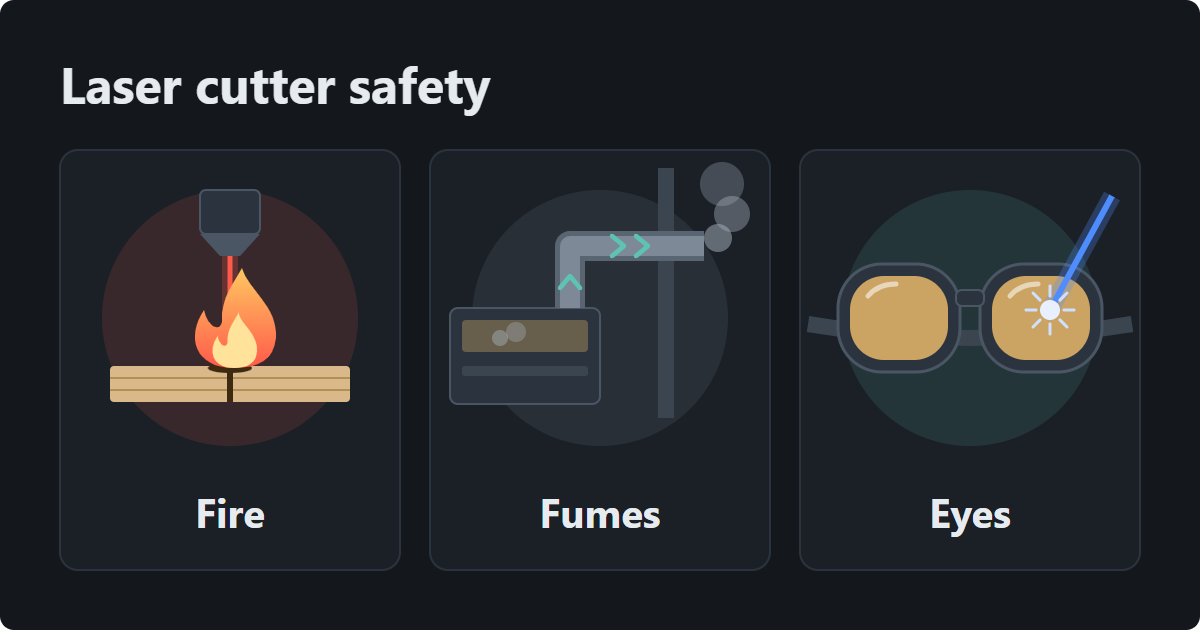
In short
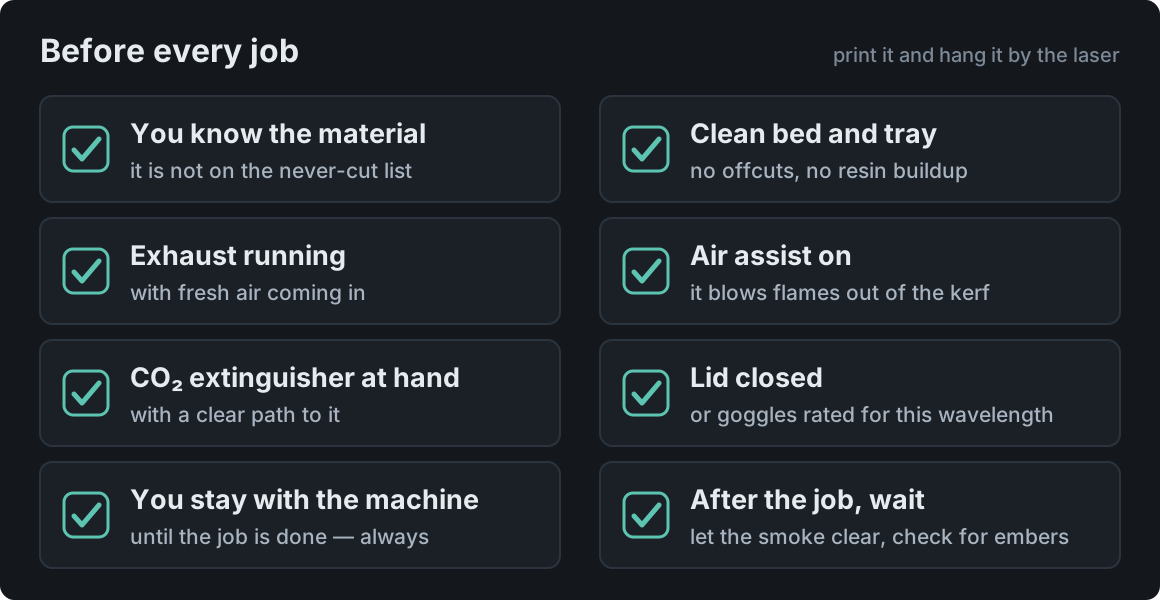
- Never leave a running laser — not even for a minute. Keep a CO₂ extinguisher next to the machine and a smoke detector in the room.
- Vent fumes outside through a short duct with the fan near the outlet. A filtration unit is the fallback when you can't run a duct out of the building.
- Goggles must carry an OD rating for your laser's wavelength. Goggles for a 450 nm diode are not CO₂ goggles (10,600 nm) — and vice versa.
- Never cut PVC, vinyl, faux leather, polycarbonate, ABS or fiberglass. If you don't know what a material is, don't cut it.
A checklist before every job
Eight things to check before you hit Start. After a week it's a habit, and it takes less time than setting focus. New to lasers? Start with our laser cutter guide.
Fire — the most common hazard
A laser cuts by burning material at a single point. Usually that's just a glow in the kerf, but with a slow speed, weak air assist or resin in the wood a small flame can grow within seconds. And the machine has plenty of fuel: the sheet, offcuts underneath, residue on the bed.
- Never unattended. Not “just grabbing the mail”, not “back in a second”. Flame sensors on newer machines help, but they don't replace you.
- A CO₂ extinguisher by the machine, with a clear path to it. It leaves no powder to work its way into rails, optics and electronics. A dry chemical (ABC) extinguisher will put a fire out too, but the machine will need a thorough cleanup afterwards.
- Clean bed and tray. Small parts that fall through the honeycomb and resin buildup are the first things to catch fire. Empty the tray regularly, not “when it's full”.
- Air assist on when cutting — the airflow blows flames out of the kerf.
- A smoke detector in the room and nothing flammable next to the machine: solvents, offcut piles, cardboard.
If something catches fire
- Stop the job (pause or stop) so the beam stops heating the material.
- Turn off air assist — with the head standing still, compressed air only feeds the fire. If you use a filter-based fume purifier, turn it off too — it could suck embers into the filter.
- A small flame usually dies on its own a few seconds after the beam stops. If it doesn't, open the lid and aim the extinguisher at the base of the flame.
- Stay with the machine afterwards. Charred wood can smolder for minutes. Remove the burned part once it has cooled.
- If the fire spreads beyond the machine, get out and call your local emergency number (911 in the US, 112 in the EU).
Flare-ups are most common when cutting too slowly and with duplicate lines in the file — the laser runs the same path twice and overheats the edge. The first you fix with a material test (the fastest setting that still cuts through also puts the least heat into the wood), the second by checking the file before cutting. In Laser MTS that's what Preflight does: it flags duplicate lines and removes them with one click. For more on flames and scorched edges, see How to prevent laser burn marks.
Fumes — what you breathe and how to vent it
Laser smoke is more than a campfire smell. Even clean wood produces fine dust that goes deep into the lungs, plus tar and volatile organic compounds. Glued sheets (plywood, MDF) add formaldehyde from the glue, and acrylic gives off sharp-smelling vapors. That's why extraction is a must even with “safe” materials.
| Venting outside | Filtration unit | |
|---|---|---|
| How it works | a fan pushes the smoke through a duct out of a window or wall | smoke passes a pre-filter, HEPA and activated carbon, and the air returns to the room |
| Effectiveness | best — the smoke leaves the room | good for dust and odor while the filters aren't saturated; carbon doesn't catch every gas (e.g. carbon monoxide) |
| Running costs | a fan and a duct, once | replacement filters; cutting wood saturates the carbon quickly |
| When | whenever you can | when there's no way to run a duct outside, e.g. in an apartment |
A few rules that make a real difference:
- Keep the duct short, with as few bends as possible. Smooth rigid duct moves more air than flexible corrugated hose.
- Put the fan near the outlet, not the machine. The whole duct then runs under negative pressure: a leak pulls air in instead of blowing smoke into your shop.
- Give the air a way in — a cracked window or a vent. If a gas water heater, furnace or fireplace shares the space, a strong exhaust fan can pull combustion gases back indoors. Make sure there's make-up air and a carbon monoxide detector.
- Keep the outlet away from windows — yours, your neighbors' and any air intakes.
- Let the exhaust run a bit after the job. Open the lid once the chamber is clear.
- Clean the duct and fan of tar buildup — it's flammable too.
Eyes — laser class and goggles
A shop laser beam damages the eye faster than you can blink — reflections off the work or a metal bed included. Whether you need goggles depends on the laser class on the rating label and in the manual. For the other differences between the two common machine types, see CO₂ vs diode laser.
| Class | What it means | Example | Goggles |
|---|---|---|---|
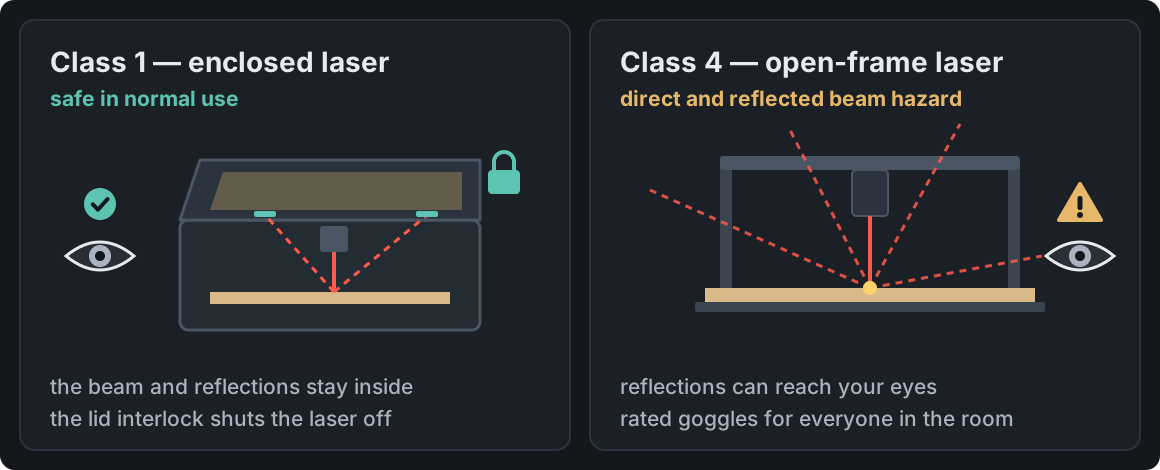
| 1 | beam enclosed, with a lid interlock and a window that blocks the radiation | enclosed CO₂ and diode machines certified as Class 1 | not needed while the lid is closed and the interlocks work |
| 2 | low-power visible light (up to 1 mW); the blink reflex protects against a brief flash | low-power pointers and aiming dots | don't stare into the beam |
| 3R, 3B | direct beam hazardous to the eye (3R up to 5 mW, 3B up to 0.5 W) | low-power engraving modules | yes, with an exposed beam |
| 4 | above 0.5 W — direct and reflected beam hazard, burns skin, ignites material | open-frame diode lasers, CO₂ lasers without an enclosure or with the lid open | yes — for everyone in the room |
Class 1 refers to the whole machine, not the laser source. The lid interlock shuts the laser off when the lid opens, and the window blocks the radiation. So never bypass interlocks or run with the lid up — the machine stops being Class 1.
Goggles: wavelength and OD are what count
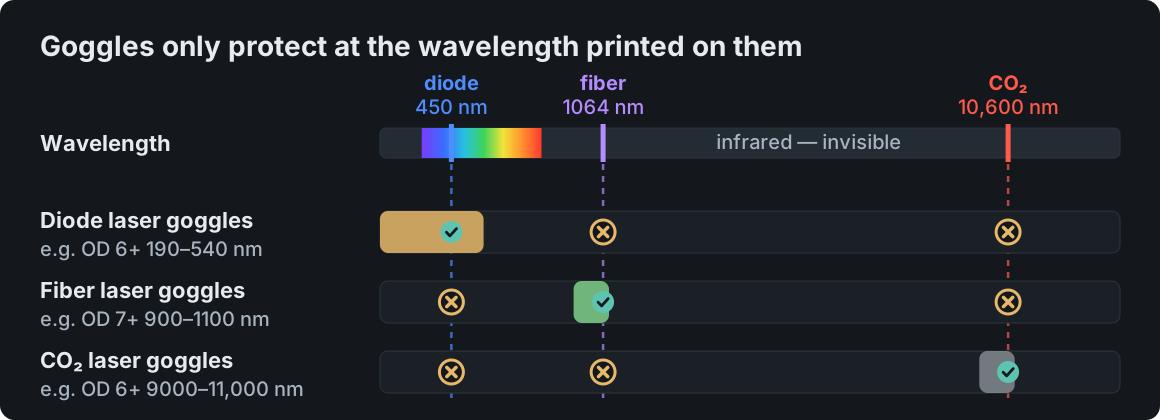
OD (optical density) tells you how much the goggles attenuate the light: OD 4 means 10,000 times, OD 6 a million times. But only at the wavelengths printed on the frame or lens.
- Diode lasers usually emit at 445–455 nm (blue). Their goggles are orange or red and rated for that wavelength.
- CO₂ lasers run at 10,600 nm — far infrared, invisible. CO₂ goggles are often clear, so blue diode light passes straight through them.
- Fiber lasers and infrared modules (around 1064 nm) need yet another pair.
- Machines with two sources (e.g. a diode and an infrared laser in one head) need goggles rated for both wavelengths.
Look for goggles marked with the wavelength (or range) and the OD at that wavelength: in the US, ANSI Z136.1 calls for exactly that labeling, and in Europe eyewear is marked per EN 207 with an “LB” protection level. Unmarked goggles thrown in with cheap lasers are worth replacing. And one more thing: goggles for everyone in the room with an open laser, kids and visitors included.
Materials: never, with care, OK
| Material | Verdict | Why |
|---|---|---|
| PVC, vinyl | never | releases hydrogen chloride when burned — harms your lungs and, with moisture, forms an acid that corrodes mirrors, rails and electronics |
| Faux leather | never | often PVC or a plastic of unknown makeup |
| Polycarbonate | never | burns and discolors instead of cutting |
| ABS | never | melts, catches fire easily, and the fumes are toxic |
| Fiberglass, carbon fiber | never | the fibers don't cut and the resin gives off toxic smoke |
| PTFE (Teflon) | never | releases toxic fluorine compounds when it breaks down |
| Pressure-treated lumber | never | treatments contain copper compounds; older ones also chromium and arsenic |
| Unknown material | never | you don't know what you're burning — ask the supplier for the safety data sheet (SDS) |
| MDF, HDF | with care | lots of smoke and formaldehyde-based glue — only with good extraction |
| Foam (EVA, PE) | with care | melts and ignites easily — thin, known material only |
| Leather | with care | vegetable-tanned only; chrome-tanned leather can release harmful chromium compounds |
| Paper, cardboard | with care | ignites in an instant — strong air assist and full attention |
| Plywood, wood | OK | campfire smoke, so extraction is a must; laser plywood cuts cleaner than construction grade |
| Acrylic (PMMA) | OK | cuts beautifully but flares up when cut too slowly; don't confuse it with polycarbonate |
| Felt, cork, cotton | OK | flammable — never leave them unattended |
| Glass, stone | OK | surface engraving only (same for anodized aluminum) |
You can spot PVC by the label, the SDS or recycling code 3. Treat self-adhesive films, banners, faux leather and “mystery plastic” from the hardware store as suspect until you've checked what they're made of.
Power, cooling and people around
- High voltage. A CO₂ tube's power supply produces tens of thousands of volts. Don't open the power supply or tube covers — service only per the manufacturer's manual, with the machine unplugged.
- Grounding. Plug the machine into a properly grounded outlet, with no adapters that skip the ground pin.
- CO₂ tube cooling. Start the water circulation before the job — an overheated tube can crack.
- Kids and pets out of the room while an open-frame laser runs.
Frequently asked questions
Is it safe to use a laser cutter at home?
Yes, if you stick to the rules: venting outside or a filtration unit, constant supervision, an extinguisher by the machine, goggles with an open laser and only materials you can identify. In an apartment the biggest problem is smoke — plan the extraction before you buy.
Do I need safety glasses with an enclosed laser?
With a Class 1 machine, the lid closed and working interlocks — no. With an open-frame diode laser — always, for everyone in the room.
What fire extinguisher should I keep by a laser cutter?
A CO₂ extinguisher — it puts out the fire without powder that ruins optics and electronics. Afterwards keep watching the material, because wood can keep smoldering.
Are plywood laser fumes toxic?
Yes. They contain fine dust, tar and compounds from the glue, including formaldehyde. Venting outside or a filtration unit is necessary even for wood.
How can I tell if a plastic is PVC?
Most reliably from the label, the safety data sheet or recycling code 3. If you have none of those, don't cut it.