 Laser MTS
In short
- Price = material with waste + laser time × your rate + your labor (file, setup, finishing, packing) + markup.
- The machine itself usually costs a couple of dollars per hour ($1.92 in the example). Your time is the expensive part — a laser runs under supervision.
- Price material as sheet price ÷ parts per sheet, not part area × price per square foot. That way the waste is already included.
- Fixed costs spread over the pieces: in the example one ornament costs $40.39, 50 cost $3.01 each, 200 cost $2.43 each.
- Your minimum order and quantity breaks fall straight out of this math.
What goes into the price of a laser job
- Material — including the waste between parts and a spare for a test cut.
- Laser time — from your laser software’s preview (LightBurn shows an estimated job time) plus a 10–20% buffer — the estimate runs short when the speed and acceleration values in Device Settings don't match your controller. Check it with a stopwatch on the first sheet.
- File prep — design or fixes, converting text to curves, a proof for the customer to approve.
- Setup — loading the sheet, focusing, a test cut. Once per job, plus a moment for each extra sheet.
- Finishing — weeding parts, peeling masking tape, wiping soot, sanding or oiling.
- Packing and extras — bags, ribbon, boxes, labels.
- Markup — your profit plus a buffer for risk (rejects, remakes, revisions).
Electricity, the tube, lenses and maintenance are not separate lines — they go into the machine’s hourly rate.
Your laser hourly rate — work out your own
The rate is the cost of one hour in which the laser is actually running. It covers the machine and you, because a laser must never run unattended. An example for a 60 W CO₂ laser:
| Item | Assumption (example) | Per hour |
|---|---|---|
| Purchase (depreciation) | $5,000 with chiller and exhaust, spread over 4 years of 1,000 running hours | $1.25 |
| Tube | $380, replaced about every 2,000 hours | $0.19 |
| Electricity | about 1.2 kW (laser, chiller, exhaust fan, air pump) × $0.15/kWh | $0.18 |
| Maintenance and parts | lens, mirrors, belts, filters: $300 a year | $0.30 |
| Machine total | $1.92 | |
| Your time | an hour including overhead (self-employment tax, rent, insurance, software, marketing) | $42.00 |
| Laser hour | machine + you at the machine | $43.92 ≈ $0.73/min |
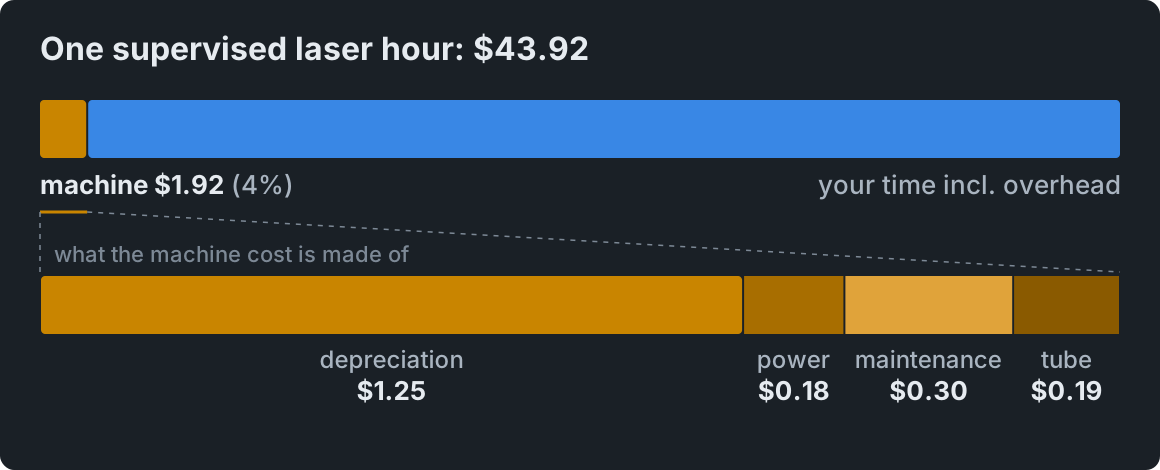
Two traps. First, machine hours: count only the hours the laser is actually cutting. If it runs 500 hours a year instead of 1,000, depreciation doubles to $2.50/h. Second, your rate: divide your yearly costs and pay by the hours you actually sell — often 100–120 a month, not 170. The rest goes to email, buying supplies, product photos and bookkeeping.
A full example: 50 name ornaments
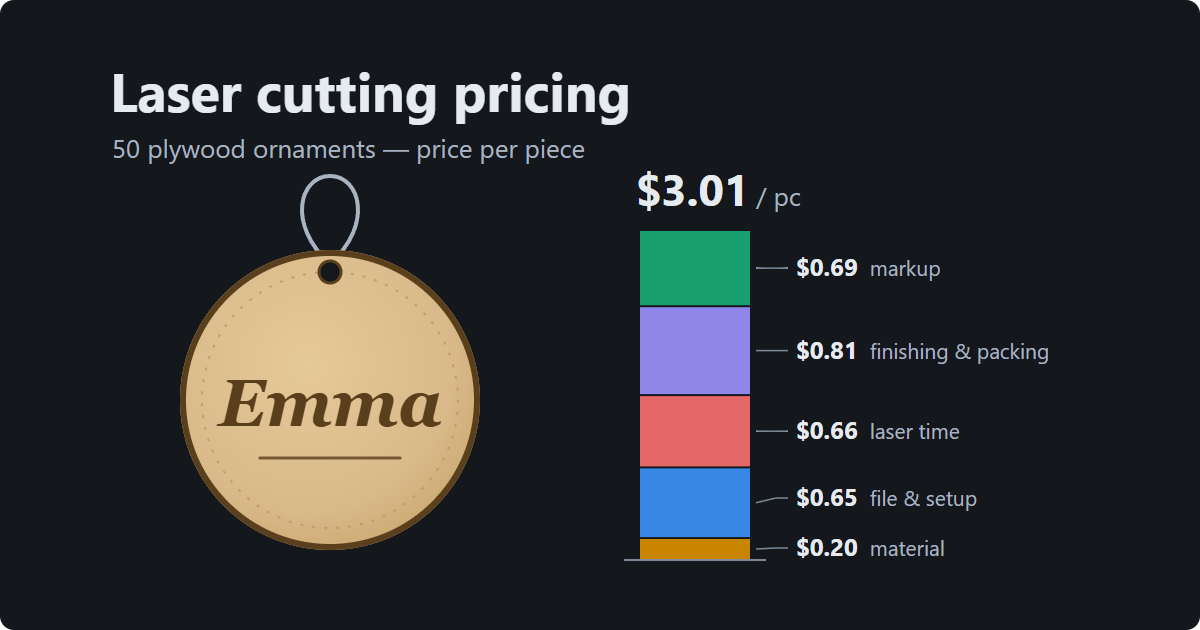
A customer orders 50 round 2.75″ (70 mm) ornaments in 1/8″ Baltic birch, each with a different name and a hole for ribbon. Assumptions:
- a 12 × 20″ sheet at $4.80 holds 24 ornaments (4 × 6 with a 1/8″ gap and 3/16″ margin), so material is $4.80 ÷ 24 = $0.20 each;
- laser time 0.9 min each (engraving the name and cutting out, from the software preview plus a buffer);
- file prep: 30 min (name list from the customer, layout, spell check); setup: 10 min + 2 min per sheet;
- finishing 0.5 min each, packing 0.3 min each + $0.25 for a bag and ribbon;
- rates from the table above, 30% markup.
| Item | Calculation | Amount |
|---|---|---|
| Material | 50 × $0.20 | $10.00 |
| Laser time | 50 × 0.9 min = 45 min × $43.92/h | $32.94 |
| File prep | 30 min × $42/h | $21.00 |
| Setup | 10 min + 3 sheets × 2 min = 16 min × $42/h | $11.20 |
| Finishing | 50 × 0.5 min = 25 min × $42/h | $17.50 |
| Packing | 15 min × $42/h + 50 × $0.25 | $23.00 |
| Total cost | $115.64 | |
| Markup 30% | $115.64 × 0.30 | $34.69 |
| Job price | before sales tax | $150.33 |
| Per piece | $150.33 ÷ 50 | $3.01 |
A few things jump out. Material is only $10 out of $150 — with plywood and small parts it’s the smallest line. Time is what costs money: laser, file, finishing and packing. And one more: a 30% markup is not a 30% margin. The $34.69 profit is 23% of the price. If you want a 30% margin, the price has to be cost ÷ 0.7.
The job takes three sheets, but only two parts go on the last one. If you use the rest of that sheet on the next job, price material per piece as above. If the offcut ends up in the trash, charge for the whole sheet.
Why the price per piece drops with quantity
File prep and setup cost the same for 5 pieces as for 200. The bigger the order, the smaller their share of each piece. Variable costs (material, laser, finishing, packing) come to $1.67 per piece in the example, so with markup the price never drops below $2.17.
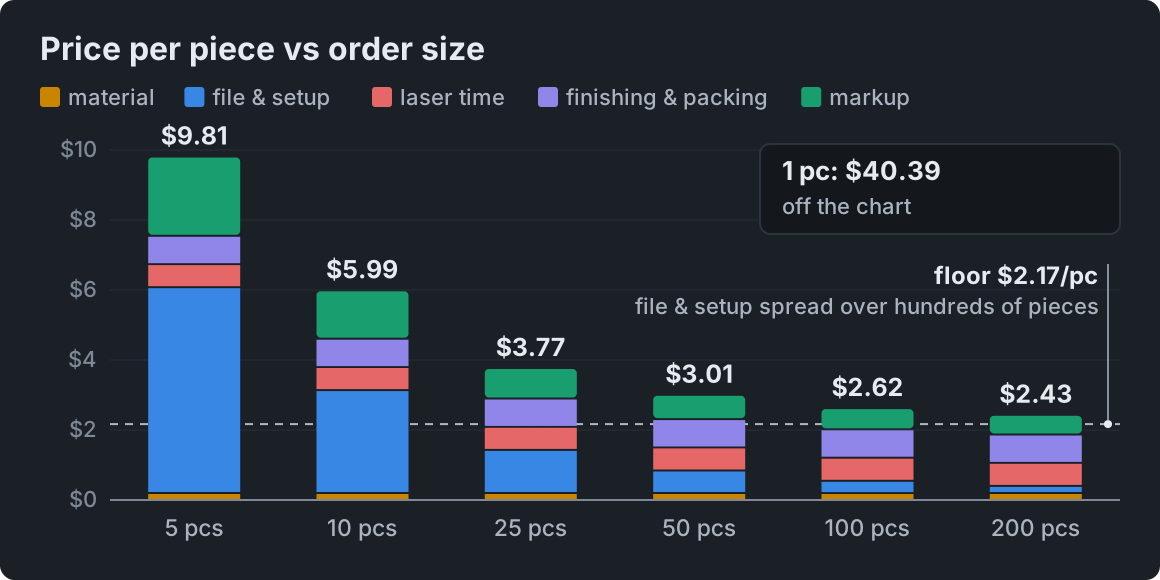
The same math gives you a fair price list with quantity breaks. Price each tier at its smallest quantity and round up — a bigger order within the same tier earns you slightly more, never less:
| Quantity | Price per piece |
|---|---|
| 10–24 pcs | $6.00 |
| 25–49 pcs | $3.80 |
| 50–99 pcs | $3.05 |
| 100–199 pcs | $2.65 |
| 200+ pcs | $2.45 |
Minimum order and one-off pieces
A single ornament in this model costs $40.39 — and that’s not a mistake. Thirty minutes on the file and 12 minutes of setup don’t go away when a customer wants just one. Two ways out:
- A minimum order — e.g. about $40, which is file prep and setup plus markup ($38.22 in the example). The customer gets a few pieces for it, or pays the minimum.
- Ready-made designs — when the template exists and you only change the name, prep takes 5 minutes instead of 30. A single piece then drops to $17.64. A catalog of ready designs is the easiest way to make small orders affordable. Ideas for such designs are in Laser-cut products to sell, and how to prepare the list and merge in names is in Laser batch personalization.
Less waste, less time — that’s where the savings are
You influence the price mainly in two ways: how many parts fit on a sheet and how many minutes the laser runs. In the example, staggering every other row by half an ornament fits 25 on the same 12 × 20″ sheet instead of 24 — only $0.40 on material in this order, because the sheet is small and cheap. More telling: 50 ornaments now fit on exactly two sheets instead of three, so a whole sheet change drops out. With larger parts and pricier stock (acrylic, hardwood, 1/4″ plywood) the same improvement is worth far more, and on long runs every saved sheet counts. More on this in our guide to nesting for laser cutting.
This is where software that does it for you pays off. In Laser MTS, nesting packs parts on the sheet for you (on the Pro plan also on offcuts from earlier jobs), and Production orders (Pro plan) lay out a whole order and show how many sheets it takes, material utilization and estimated cut time. From your unit prices they also prepare a quote for the customer, with a discount if you offer one.
Common pricing mistakes
- Charging only for laser time — and forgetting file prep, setup, finishing and packing. In the example the laser is less than a third of the cost ($32.94 of $115.64).
- Material by part area instead of by sheet. A 2.75″ ornament covers about 6 square inches, but on the sheet it takes up one twenty-fourth of it (10 in²).
- A rate based on 170 hours a month, as if every hour were billable.
- No allowance for rejects — add 1–2 spare pieces or a few percent of material.
- Confusing markup with margin.
- The same price for 1 and for 100 pieces — you lose money on small jobs and look expensive on big ones.
- Unlimited free revisions — include one round, quote the rest separately.
Frequently asked questions
How much should I charge per minute of laser time?
It depends on your machine and your costs. In the example the cost is $0.73 per minute, or about $0.95 with a 30% markup. It’s worth knowing what other shops charge, but price from your own costs — otherwise you may be selling below them.
How do I price laser engraving?
The same way as cutting: engraving time from the software preview, artwork prep, setup and finishing. A filled engraving usually takes far longer than cutting an outline of the same size, because the head sweeps the whole area line by line — see our guide to laser engraving wood.
Should I quote customers per minute or per piece?
Per piece or per job, with quantity breaks. The per-minute rate is your tool for doing the math, not a price the customer can judge.
What markup should a laser business use?
There’s no single number. The calculated price is your floor — below it you lose money. With personalized products customers pay for the result, so check what similar items sell for; you can often charge well above cost plus 30%.